
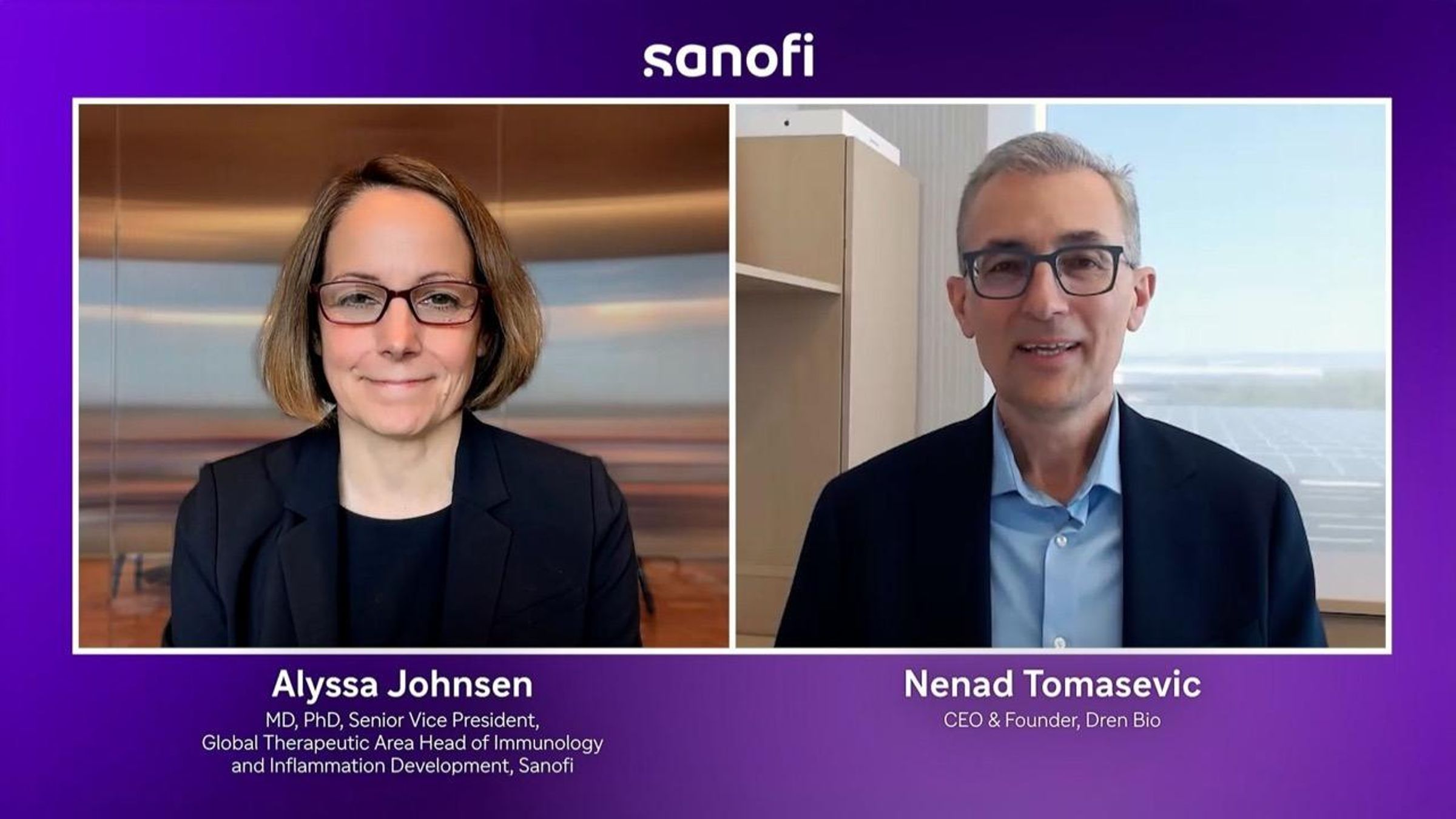
Welcome to the latest episode of our Partner Spotlight series, where we explore how Sanofi is collaborating with innovative companies to transform the future of medicine. In this episode, Alyssa Johnsen, Global Therapeutic Area Head of Immunology and Inflammation Development at Sanofi, sits down with Nenad Tomasevic, Founder and CEO of Dren Bio, to discuss the evolving science of immune reset, the next generation of B-cell depletion therapies and why strategic partnerships are helping advance innovation in immunology.
In 2025, Sanofi expanded its strategic collaboration with Dren Bio to advance next-generation therapies for immune-mediated diseases. By combining Dren Bio's expertise in myeloid cell engager technology with Sanofi's deep immunology and development capabilities, the collaboration aims to explore new approaches to immune modulation that have the potential to address significant unmet patient needs.
As our understanding of immune-mediated diseases continues to deepen, researchers are moving beyond simply suppressing inflammation toward therapies that may fundamentally rebalance the immune system. To explore this shift, Alyssa Johnsen and Nenad Tomasevic discuss how advances in B-cell biology, myeloid cell engagement and strategic collaboration are reshaping the future of immunology research.
Dren Bio is a clinical-stage biotechnology company focused on developing targeted therapies that harness the body's natural immune mechanisms to eliminate disease-causing cells. Under Tomasevic's leadership, the company is advancing innovative approaches designed to selectively engage the immune system while improving precision and expanding therapeutic possibilities.
Together, Sanofi and Dren Bio are exploring how new scientific insights into immune biology could help drive the next generation of therapies for patients living with chronic immune-mediated diseases.
Moving Beyond Broad Immune Suppression
For many years, therapies for autoimmune diseases focused on broadly suppressing immune activity to reduce inflammation. While these approaches have transformed care for many patients, scientists increasingly recognize the need for treatments that address the underlying biology driving disease.
"B-cells are a key part of the adaptive immune system," explained Tomasevic. "However, certain B-cells can become dysregulated and contribute to chronic inflammation and tissue damage."
As researchers have learned more about immune biology, the field has steadily moved toward more targeted approaches that selectively influence specific components of the immune system. Rather than simply controlling symptoms, researchers are increasingly investigating therapies that may help restore immune function and potentially deliver longer-lasting disease control.
Harnessing the Body's Natural Biology
One of the most exciting areas of investigation is understanding how the body's own immune cells can be leveraged in new ways.
Johnsen described growing interest in myeloid cells. These are an important part of the innate immune system that not only helps defend against pathogens but also performs essential housekeeping functions by removing dead or damaged cells through phagocytosis.
"If we can harness that homeostatic mechanism of control," she explained, "we could use this to remove unwanted pathogenic cells."
Researchers believe that applying these natural biological processes more selectively could open new possibilities for immune modulation while maintaining the immune system's normal balance.
The Power of Scientific Partnership
Both leaders emphasized that advances in complex scientific fields rarely happen in isolation.
"The complexity of modern immunology often requires bringing together different types of expertise," said Tomasevic. "Partnerships allow organizations to combine complementary expertise and different scientific perspectives."
For Tomasevic, the ultimate value of partnerships extends well beyond the agreement itself.
The goal isn't simply to complete a deal, it's to create the right environment for promising science to succeed and ultimately reach patients.

Nenad Tomasevic
For Sanofi, partnerships have always been an important part of how the company advances science.
Innovation doesn't happen in a vacuum. We work within a large ecosystem that requires collaboration to make sure we can deliver novel therapies as quickly and efficiently as possible, because that's what patients are waiting for.

Alyssa Johnsen
Looking Ahead
As immunology research continues to evolve, both leaders believe organizations will need to become increasingly interdisciplinary, bringing together expertise across biology, engineering, translational medicine and clinical development.
Tomasevic also emphasized the importance of fostering scientific cultures that encourage curiosity, challenge assumptions and embrace continuous learning.
"We are seeing a much closer integration between the agility and scientific innovation that often comes from biotech companies and the development, manufacturing and global clinical expertise that larger organizations can provide," Tomasevic said.
For Johnsen and Tomasevic, the future of immunology will be shaped not only by advances in biology, but also by the ability to combine complementary expertise through long-term scientific collaboration.
The next generation of immune-mediated disease treatments will require bold science, and innovative thinking that bring together the best ideas from across the research ecosystem. If you missed our first episode focused on AI and drug discovery, please click here. Stay tuned for our next Partner Spotlight, where we'll explore how collaboration is driving innovation across the evolving landscape of biomedical research.