
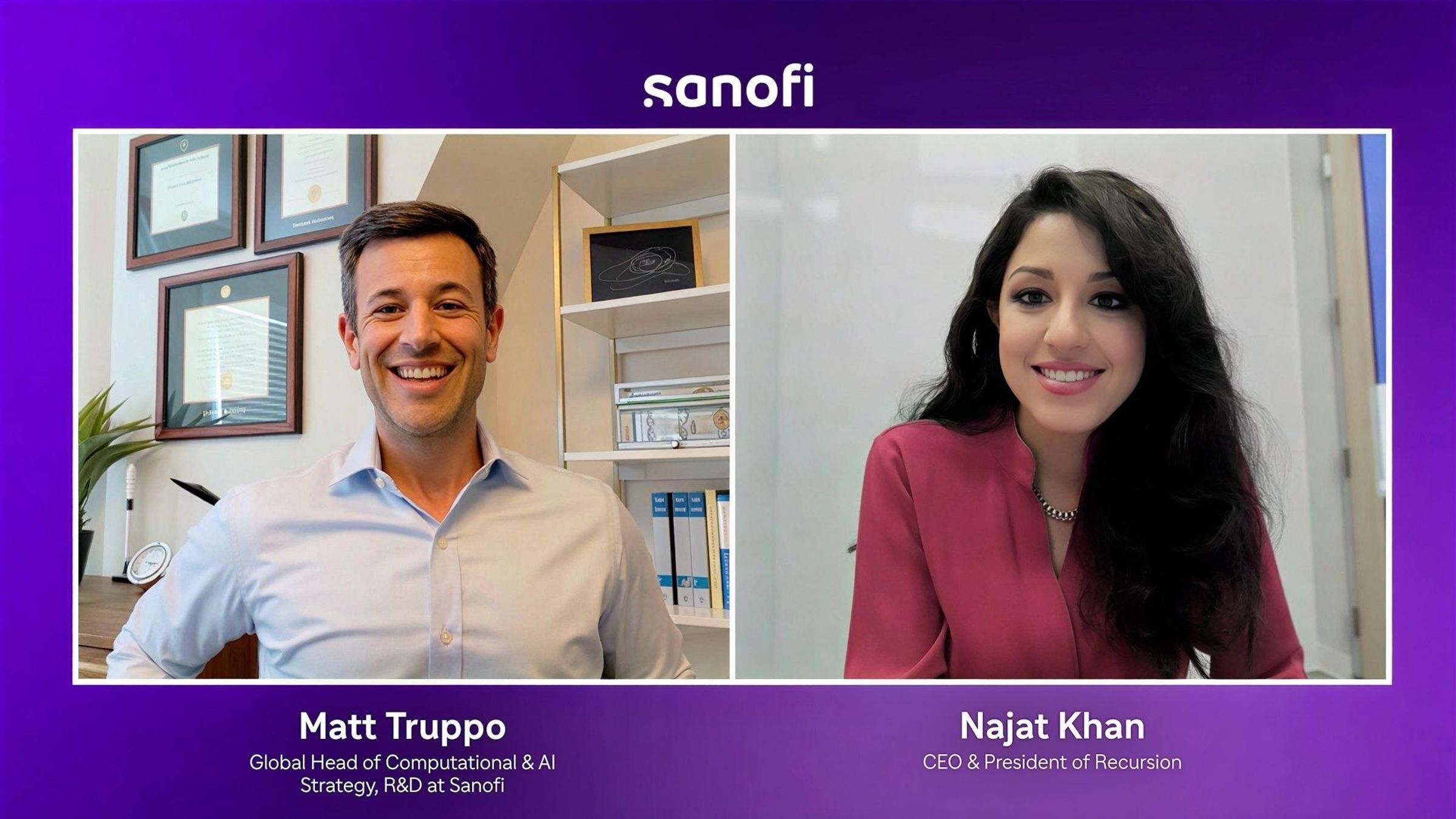
Welcome to our Partner Spotlight series, where we explore how Sanofi is collaborating with innovative companies to transform the future of medicine. In this inaugural episode, Matt Truppo, our Global Head of Computational & AI Strategy, R&D at Sanofi, sits down with Najat Khan, the CEO and President of Recursion, to discuss how artificial intelligence is revolutionizing drug discovery—and why strategic partnerships are essential to unlocking AI's full potential in bringing new therapies to patients.
In 2022, Sanofi and Recursion announced a partnership to discover and develop AI-enabled small molecule therapies across immunology and oncology. Since launching the collaboration, the teams have advanced multiple discovery programs and achieved several development milestones, demonstrating how the combination of Recursion’s AI-driven discovery platform and Sanofi’s R&D expertise can help accelerate the identification of novel therapeutic opportunities.
As artificial intelligence continues to transform industries, its effect on drug discovery could be among the most significant, fundamentally changing how scientists identify targets, design molecules and bring new therapies to patients. To examine how AI is reshaping the way medicines are developed, Matt Truppo, Global Head of Computational and AI Strategy at Sanofi R&D, spoke with Najat Khan, CEO and President of Recursion, about the future of AI-driven discovery in small-molecule medicine development and the role partnerships play in advancing complex science.
Recursion is a clinical-stage biotech company that uses machine learning, automation and large-scale biological data to decode biology and accelerate therapeutic discovery. Under Khan’s leadership, the company is building integrated AI-powered systems to uncover new biological insights, identify novel targets and improve how medicines are developed.
Together, Sanofi and Recursion are exploring how the convergence of biology, chemistry, data science and artificial intelligence could fundamentally change the future of R&D.
From Hypothesis-Driven to Data-Driven Discovery
For decades, drug discovery has followed a hypothesis-driven model, with researchers testing one scientific question at a time. According to Khan, that model is now beginning to change.
"For a long time, drug discovery has really been a very artisanal, hypothesis-driven approach," she said. "We're seeing that now shift and evolve to a much more systems-based, iterative, data-driven approach that's allowing [us] to explore a larger space across both biology and chemistry."
Modern AI platforms can combine biological, chemical and clinical data in continuous learning systems, allowing researchers to generate and test hypotheses at unprecedented scale. Khan noted that while drug discovery remains complex, the industry’s growing ability to understand the “language of biology” is creating new opportunities.
Solving R&D's Biggest Challenges
Despite major scientific advances, drug discovery is still slow, costly and high risk. Many promising programs fail because the underlying biology is not fully understood.
Truppo sees AI as a way to help address many of these long-standing challenges.
"AI offers the opportunity to better connect target identification, molecule design and clinical development, rather than treating them as separate steps," he explained during the discussion.
One of AI’s greatest opportunities is improving decisions earlier in development by identifying the right targets and molecules before major time and resources are committed. Ultimately, AI could help scientists learn faster, iterate more efficiently and improve success rates across the R&D pipeline.
Why Partnerships Matter More Than Ever
While AI is creating exciting opportunities, both leaders emphasized that technological advancements alone are not enough.
There's no single organization on the planet that can be the best at everything. Partnerships uniquely allow us to bring together really specialized capabilities of truly expert practitioners.

Matt Truppo
Global Head of Computational & AI Strategy, R&D
AI-driven drug discovery sits at the intersection of biology, chemistry, clinical development and data science. As a result, successful innovation increasingly depends on combining complementary expertise.
For Khan, effective partnerships start with shared ambition.
It's so important to align early on what those big bets are that we want to work on together. When you're trying to develop a blueprint that has not existed before, it requires a shared understanding of both what we want to achieve and the ability to lean into the risk that's needed.

Najat Khan
CEO and President of Recursion
That willingness to learn together can lead to outcomes that exceed expectations. As Truppo noted, some of the strongest partnerships are those in which teams achieve more than either side initially thought possible.
Looking Ahead
As AI technologies mature, both leaders expect partnership models to evolve with them.
Khan believes future success will depend on organizations that can pair computational prediction with experimental validation, creating closed-loop systems that learn and improve continuously. She also expects greater convergence between scientific and technical expertise, with future organizations becoming increasingly “bilingual” in both areas.
For Sanofi and Recursion, the future of drug discovery will be shaped not only by technology, but also by the ability to combine innovation, expertise and collaboration in new ways.
AI may accelerate discovery, but partnerships remain essential to turning scientific potential into medicines that can make a meaningful difference for patients.
Stay tuned for our next Partner Spotlight, where we'll explore how collaboration is driving innovation across the evolving landscape of biomedical research.