Skin is our largest organ, as well as our primary defense against the outside world. Yet skin diseases often are not considered serious medical issues, even though they affect 30 to 70 percent of people worldwide.1 While diseases like atopic dermatitis (AD), chronic spontaneous urticaria (CSU), prurigo nodularis, and bullous pemphigoid (BP) all present differently, they are united by a common symptom that profoundly impacts patients’ daily lives: persistent itch.2
Though itch may seem like something restricted only to the surface of skin, it may actually be result of complex underlying inflammatory and neurological processes which can cause broader impacts that significantly disrupt how people sleep, work, and maintain social connections.3 To successfully mitigate the far-reaching burden of itch in chronic skin diseases, it is important to first understand the biological processes that drive it.
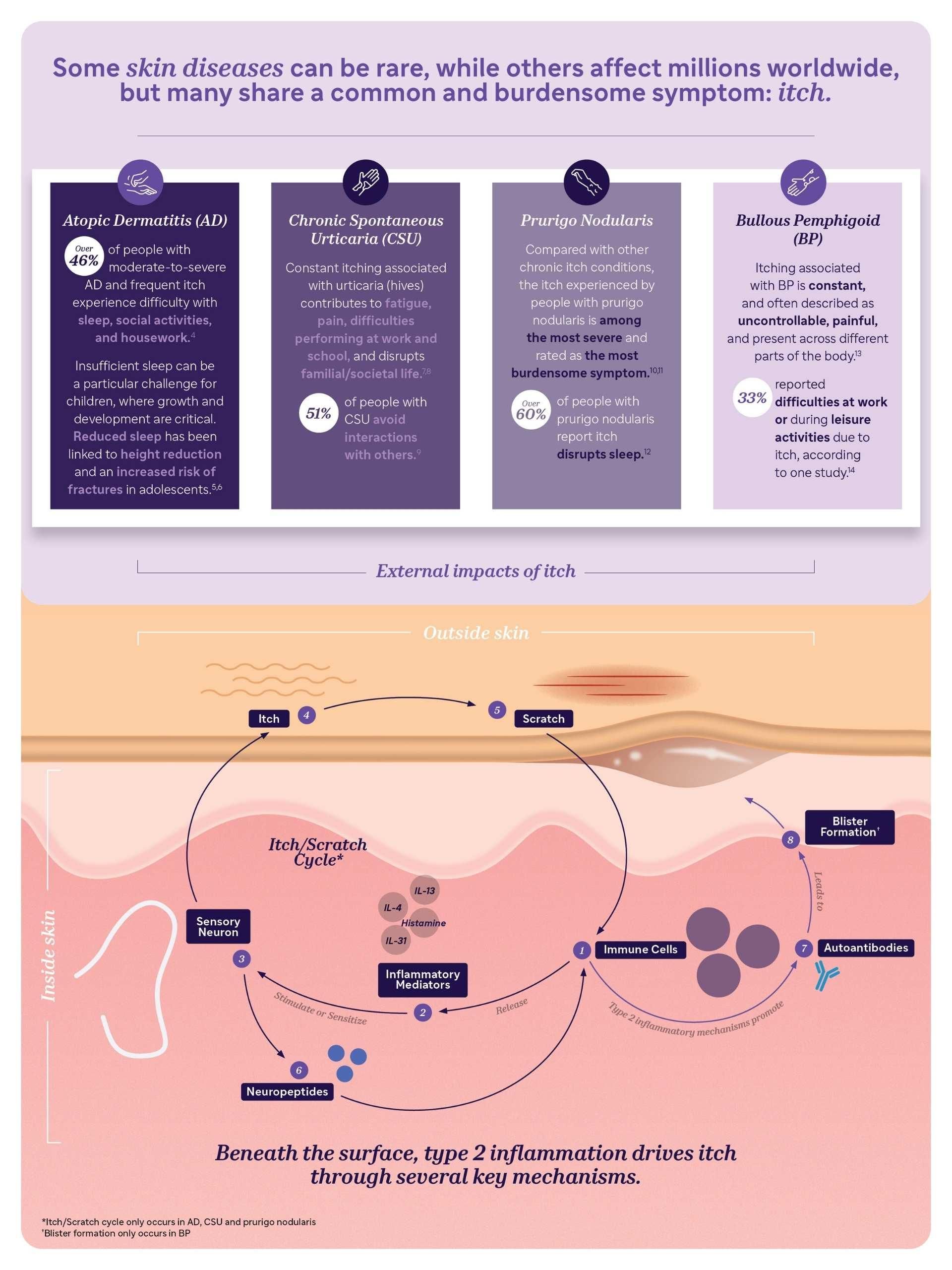
1) Immune cells, including type 2 inflammatory cells, release 2) inflammatory mediators like IL-4, IL-13, IL-31 and histamine. (15) These interact with 3) sensory neurons to sensitize them, which means they can become hyperreactive to stimuli that would normally not lead to itch or lead to augmented itch sensations. (15,16) 4) Itch sensations lead to 5) scratching, which further stimulates the immune response and sensory neuron activation, perpetuating the itch/scratch cycle.(4) Additionally, sensory neurons can release.(16) 6) neuropeptides which further stimulate the immune response and subsequent sensory nerve cell activation to promote itch, which also ramps up the itch-scratch cycle.(15) In BP, type 2 inflammation contributes to the development of 7) autoantibodies, a key factor in 8) blister formation.(15)
Looking Deeper to Better Manage Itch
Because chronic skin diseases like AD, CSU, prurigo nodularis, and BP can lead to diminished quality of life, moving beyond short-term symptom management to long-term disease control with medicines that target underlying disease processes is essential. Addressing shared biological disease drivers, like type 2 inflammation, can make a meaningful difference in how people are able to live their lives. We understand the importance of recognizing the challenges faced by people around the world living with chronic skin diseases, and are committed to scientific innovation that can help redefine what’s possible for both people living with these conditions and the clinicians who treat them.
Explore More
Tackling Atopic Dermatitis From Multiple Angles
Taking Down Type 2 Inflammatory Disease
From Wearables to "Invisibles": We're Collaborating to Study Itch in Sleeping Children
References
-
Yosipovitch, G., et al. (2024). International study on prevalence of itch: Examining the role of itch as a major global public health problem. British Journal of Dermatology, 191(5), 713–718. https://doi.org/10.1093/bjd/ljae260
-
Song, J., et al. (2018). Pruritus: Progress toward pathogenesis and treatment. BioMed Research International, 2018, 1–12. https://doi.org/10.1155/2018/9625936
-
Silverberg, J. I., et al. (2018). A comprehensive conceptual model of the experience of chronic itch in adults. American Journal of Clinical Dermatology, 19(5), 759-769. https://doi.org/10.1007/s40257-0180381-6
-
Simpson, E. L., et al. (2016). Patient burden of moderate to severe atopic dermatitis (AD): Insights from a phase 2b clinical trial of dupilumab in adults. Journal of the American Academy of Dermatology, 74(3), 491-498. https://doi.org/10.1016/j.jaad.2015.10.043
-
McKenzie, C., et al. (2020). Association between the longitudinal course of AD, sleep disturbance, and overall health in US children. The Journal of Allergy and Clinical Immunology, 8(2), 812-814.e1. doi:10 .1016/j.jaip.2019.08.027
-
Silverberg, J. I., Paller A. S. (2015). Association Between Eczema and Stature in 9 US Population-Based Studies. JAMA Dermatology, 151(4), 410-409. doi:10.1001/jamadermatol.2014.3432
-
Balp, M. M., et al. (2015). The Impact of Chronic Urticaria from the Patient's Perspective: A Survey in Five European Countries. The patient, 8(6), 551–558. https://doi.org/10.1007/s40271-015-0145-9
-
Gonçalo, M., et al. (2020) The global burden of chronic urticaria for the patient and society. British Journal of Dermatology, 184(2), 226-236. https://doi.org/10.1111/bjd.19561
-
Sanofi. (2025). Chronic Spontaneous Urticaria is an Immune-Mediated Inflammatory Skin Disease. Sanofi Campus. https://pro.campus.sanofi/sa/chronic-spontaneous-urticaria-csu/articles/chronic-spontaneous-urticaria-is-an-immune-mediated-inflammatory-skin-disease
-
Pereira, M.P., et al. (2020). Chronic nodular prurigo: clinical profile and burden. A European cross-sectional study. Journal of the European Academy of Dermatology and Venereology, 34, 2373-2383. https://doi.org/10.1111/jdv.16309
-
Aggarwal, P., et al. (2021). Clinical characteristics and disease burden in prurigo nodularis. Clinical and Experimental Dermatology, 46(7), 1277-1284. https://doi.org/10.1111/ced.14722
-
Gwillim, E. C., et al. (2021). Impact of Itch on Sleep Disturbance in Patients with Prurigo Nodularis. Acta Dermato-Venereologica, 101(3), adv00424. https://doi.org/10.2340/00015555-3778
-
Ho. C. N., et al. (2025). Patient Experiences of Bullous Pemphigoid: Symptoms and Health-Related Quality of Life Impacts. Dermatol Ther (Heidelb), 15(7), 1813-1831. https://doi.org/10.1007/s13555-025-01424-z
-
Briand, C., et al. (2020). Characteristics of Pruritus in Bullous Pemphigoid and Impact on Quality of Life: A Prospective Cohort Study. Acta Dermato-Venereologica, 100(18), adv00320. https://doi.org/10.2340/00015555-3683
-
Garcovich, S., et al. (2021). Pruritus as a Distinctive Feature of Type 2 Inflammation.Vaccines,9(3),303. https://doi.org/10.3390/vaccines9030303
-
Kabata, H., & Artis, D. (2019). Neuro-immune crosstalk and allergic inflammation. The Journal of clinical investigation, 129(4), 1475–1482. https://doi.org/10.1172/JCI124609